HC7 Planetary Ransomware May Be the First to Accept Ethereum
A new variant of the HC7 Ransomware is in the wild that encrypts a victim’s files and appends the .PLANETARY extension to the filename. What makes this particular ransomware variant unique is that it may be the first one that accepts Ethereum as a ransom payment.
HC7 Planetary Ransomware Ransom Note
Almost all ransomware utilize Bitcoin for the ransom payment, with a few requesting Monero. Now that Ethereum is currently selling for over $1,200 per coin and rising in price and popularity, it’s not surprising that we see criminals accepting it as a payment.
While a cryptocurrency like Monero, or even Verge, makes more sense due to their greater privacy and being less traceable, Ethereum’s smart contract feature could make ransomware payment processing more efficient. Using Ethereum’s smart contracts, a criminal could make a “honest ransomware“, where a victim guarantees payment if the developer actually decrypts the victim’s files.
While no ransomware currently uses Ethereum smart contracts for payments and most likely will not due to its complexity, that is really the only good reason to use Ethereum over other cryptocurrencies. In the future, I would expect developers to move away from Bitcoin and start moving more towards Monero and XVG due to them being “privacy” related coins.
What we know about the HC7 Planetary Ransomware
As for the HC7 Planetary variant, we do not know much more than it is currently being distributed via the developer hacking into networks using remote desktop. Once they gain access to the network they will manually install the ransomware on all machines they can gain access to.
Example of what a Planetary Encrypted Folder Looks Like
As the ransomware is manually installed and typically cleaned up by the developer afterwards, finding a sample is not easy. Bleeping Computer only learned about this variant because a victim reached out to us for help.
When infected, the developers allow a victim to decrypt a single machine for a set price or the entire network for another price. As you can see from the ransom note below, the current ransom amount is $700 per machine or $5,000 for all of the machines on the network.
In the past, a method to decrypt HC7 encrypted files was discovered by performing memory forensics on a victim’s computer in order to retrieve the password used on the command line when the ransomware was installed. The change of success using this method, though, diminishes the longer the computer is in use and no longer works at all if the computer has been rebooted.
IOCs
HC7 “Planetary” Ransom Note:
ALL FILES ARE ENCRYPTED.  TO RESTORE, YOU MUST SEND $700 EQUIVALENT FOR ONE COMPUTER OR $5,000 FOR ALL NETWORK PAYMENTS ACCEPTED VIA BITCOIN, MONERO AND ETHEREUM BTC ADDRESS: [bitcoin_address] MONERO (XMR) ADDRESS: [monero_address] CONTACT US WHEN ETHEREUM PAYMENT INFORMATION BEFORE PAYMENT SENT EMAIL m4rk0v@tutanota.de ALONG WITH YOUR IDENTITY: [base64_encoded_computer_name] INCLUDE SAMPLE ENCRYPTED FILE FOR PROOF OF DECRYPT
NOT TO SHUT OFF YOUR COMPUTER, UNLESS IT WILL BREAK
Every fish is an ERC-721 crypto token stored on the Ethereum blockchain.
Digital asset 100% owned by the player. It can be managed like a regular cryptocurrency — transferred or sold to any other player. It cannot be destroyed, removed or replaced.
Battle with Crypto Tokens on the Blockchain!
Hunt other fish and take a bite of them to increase your fish weight and reach top of the global leaderboards. Trade your winning fish for a better one and grow another champion!
A peer-to-peer (P2P) player-versus-player (PvP) game for growing, fighting and trading unique digital fish with community-driven economy and immutable gaming assets based on smart contracts running on the Ethereum blockchain.
How to play?
Requirements to play Fishbank: Chrome or Firefox browser installed with MetaMask extension, some Ether in your digital wallet and a stable Internet connection. Reserve your fish to join the Fishbank Alpha launch.
Being a cryptographically unique token every fish has its own image compiled by a special algorithm using all the parameters of certain fish. Fish with the same parameters and size may differ in colors.
Goldman Sachs predicts that chipmaker Nvidia is headed for another banner year, a forecast that is bullish not only for shareholders but also ethereum miners.
Goldman Sachs Predicts Profitable 2018 for Nvidia
After last year’s 109 percent increase, one might assume that Nvidia’s share price is primed for a correction.
Goldman Sachs analyst Toshiya Hari, however, predicts that 2018 will be a banner year for Nvidia, citing growth potential in the gaming and VR/AR sectors.
“Nvidia is one of the few stocks in our coverage universe exposed to multiple secular growth markets … With the emergence of eSports and the potential proliferation of VR/AR, we view Gaming as a meaningful and sustainable growth driver for the overall company,” the analyst wrote in a note to clients Friday, according to CNBC. “In terms of single stock, our top picks in Semis and Semi Cap are Nvidia and Entegris.”
Though not mentioned, this bullish forecast also assumes a solid outlook for cryptocurrency miners because the industry served as a driving force for share prices of both Nvidia and AMD, its archrival and fellow GPU manufacturer.
The two companies have become so closely associated with mining that analysts have even characterized them as proxies for cryptocurrency market movements because as prices increase and mining becomes more profitable, demand for GPUs rises as well.
Both companies have leaned into the burgeoning cryptocurrency mining sector, releasing drivers and even graphics cards designed specifically for mining-specific applications, all the while incurring the ire of their traditional gaming-focused clientele.
Nvidia Exempts Miners from Data Center Restrictions
More recently, Nvidia has even structured the license agreement for its consumer-focused GeForce and Titan graphics cards to exclude cryptocurrency mining from restrictions on using these cards in data centers, according to a report from The Register.
“No Datacenter Deployment. The SOFTWARE is not licensed for datacenter deployment, except that blockchain processing in a datacenter is permitted,” the licensing agreement reads.
This exemption allows large-scale miners to purchase high-end GeForce GTX 1080 Ti graphics cards, which retail for $699 rather than being required to fork over as much as $9,000 for enterprise-level Tesla V100 chips.
Bitcoin's volatility seems to be histrionic in nature.
Cryptocurrencies do not match historic bubbles.
Ethereum is the better, faster, and more versatile bitcoin.
Let's talk about two cryptocurrencies: Bitcoin and Ethereum and why Ethereum might be better.
What or Who Determines the Price?
Now, though some will tell you they know exactly where it will go and exactly why, I can almost guarantee you that they are either lying to you or they are lying to themselves. If you ask any economist to take a look at Bitcoin, they will tell you the same thing. The ONLY thing that is currently determining the price of bitcoin is supply and demand. All other factors are entirely endogenous factors which can be captured by the effect of supply and demand.
Now this isn't a bad or good thing. It is simply the state of affairs. Some would argue that the same stands for all assets: stocks, bonds, or whatever. And they aren't entirely wrong. With any of those asset classes, there is some tangible value behind them. Whether it be the physical assets the company holds or the cash flows a company generates. So using the assumptions of the efficient-market hypothesis, we can say that if markets behave rationally even some of the time, then the pure effect of supply-demand and individual daily sentiment should not be able to move any individual security down to zero without a rational cause.
But the environment which listed public securities operate in is different from that of cryptocurrencies. Public markets have a lot of oversight, regulatory structure (Rajgopal and Venkatachalam 1997), as well as institutional investors which act as values and levies to relieve some of that downward pressure on financial markets. Unfortunately for bitcoin, it does not have any of this, at least not yet.
With the recent rise of Bitcoin, institutional investors are beginning to take notice. Hedge funds have now entered the market for the prized asset, while new hedge funds have begun to complete financing rounds for cryptocurrency-specific funds. All this is to say that institutional investors will add to the demand side initially.
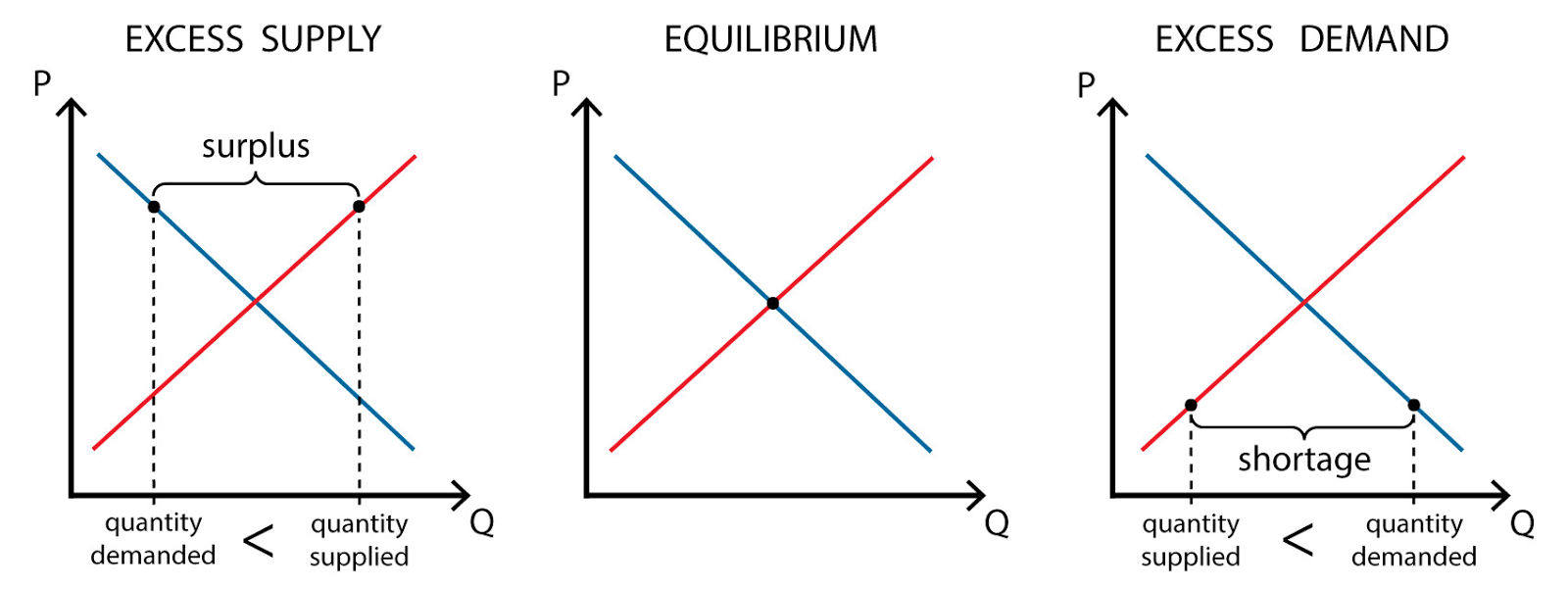
Now, I have mentioned the supply and demand quite often so far. So a quick flashback to econ 101; above you can see a standard supply and demand curve. Now, let us for one second assume perfect price elasticity of demand and look at the charts in the context of bitcoin. As demand for bitcoin increases, and as the hype surrounding bitcoin grows with its price, we can see that a seemingly endless positive feedback loop forms. In other words, people demand more bitcoin as the price increases, which in turn leads to an increase in the price which leads people to demand more and so on and so on.
In addition to this, the cryptocurrency is viewed by most as an asset rather than a currency. The result of this is a tendency to hold the asset rather than use it on a transaction basis. This means that as people demand more, the people who hold bitcoin are less willing to sell at the current price due to the probability of future appreciation. All this can be described in the graph below. The chart represents the quantity of bitcoin willing to be bought or sold in a marketplace. Do not mistake this with the total number of bitcoins outstanding. As you can see from the chart, this iterative process drives the price rapidly higher.
News and Volatility
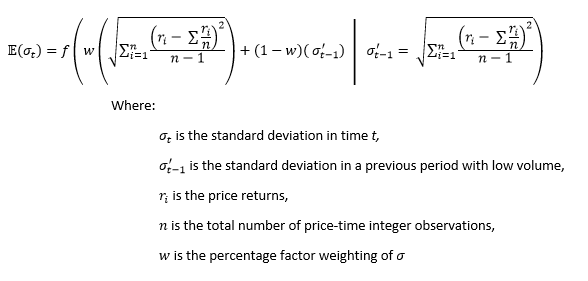
People point to positive news about various companies accepting bitcoin as the validity of the coin price. Which is correct and wrong at the same time: yes, it does have validity to it as a currency, but it makes no inference to its price. The price solely increases because to investors the risk has gone down. Strangely, however, the implied volatility of bitcoin is so high that any of these reductions to risk will send the price skyrocketing. Now there are some reasons for this; primarily it seems that the high volatility has become part of the identity of bitcoin. Mathematically a simple version of this suggests:
Note: The equation above is a working histrionic model, which I am developing and is highly subject to change. I am including it for illustration purposes, not for practical asset pricing.
I know it may seem overly complicated, but what it is suggesting colloquially is pretty straightforward. It is saying that currently it appears that the expected volatility of a bitcoin is codependent on the current implied volatility as well as some weighted factor of its past volatility during a period of characteristically high volatility given this past period volatility. Now given that Bitcoin's price only fluctuates based on supply and demand, this means that the histrionic model above, or a variation of it, is caused by people's expectations for it to occur.
Is it a Bubble?
I realize 100% that this question just triggered almost all of you. This is a phrase that has been repeated over and over again by naysayers. The opinion is that this is just a baseless slogan that means absolutely nothing and is only said by people who do not understand what cryptocurrencies are. Now no one can tell you for certain that it is or is not a bubble. But let us look at some historical examples and then see if there are similarities and differences.
Perhaps Bitcoin is the poster child for disruptive technologies. It definitely has the potential to entirely revolutionize our entire society. When Henry Ford introduced his Ford Model T, there were those that thought it was the most ludicrous idea ever. Yet, today, our entire infrastructure globally is built around his invention.
The chart above does look scary. A large number of people seem to have gained interest in whether bitcoin is a bubble or not. So let's take a look at the two best historical examples of bubbles and see what we can learn and how to navigate forward. And if currently popular cryptocurrencies resemble anything like either of those bubbles that burst so violently.
In the early 1600s in the Netherlands, a series of events occurred which are now referred to as Tulip Mania, where the price of tulips were viewed as highly coveted. Prices of tulips erupted and skyrocketed higher. Now there are highly contesting reports around the exact prices of its enormous ascent due to the lack of existing data, so I won't include a chart here. But they are accounted, though unverified, that a single tulip bulb sold for 10 times the annual income of a craftsman. One classic popular account claims a single bulb was used to purchase 12 acres of land (Mackay in Extraordinary Popular Delusions and the Madness of Crowds).
Now here is why this comparison at first seems good, but if you look at the actual existing facts, it really isn't. First of all, I do not need to point out that the era of Tulip Mania was over 350 years ago. Secondly, the circumstance of the tulip bubble is highly contested. Thompson 2006 postulated an interesting rationale for the Tulip Mania. Tulips are a seasonal flower, and as such, they traded essentially as futures contracts (contracts between growers and buyers at the time). The issue arose when the regulation was placed which allowed to pay a penalty fee of 3.5% to void the end of the contract. This entirely disrupted the payoff matrix for the future, basically allowing the buyer the right to buy at a higher price but no obligation at a lower price (now this is known as an option). The introduction of this option pricing structure to futures incentivized the holding of contracts which then is suggested to have led to the monstrous rise in price.
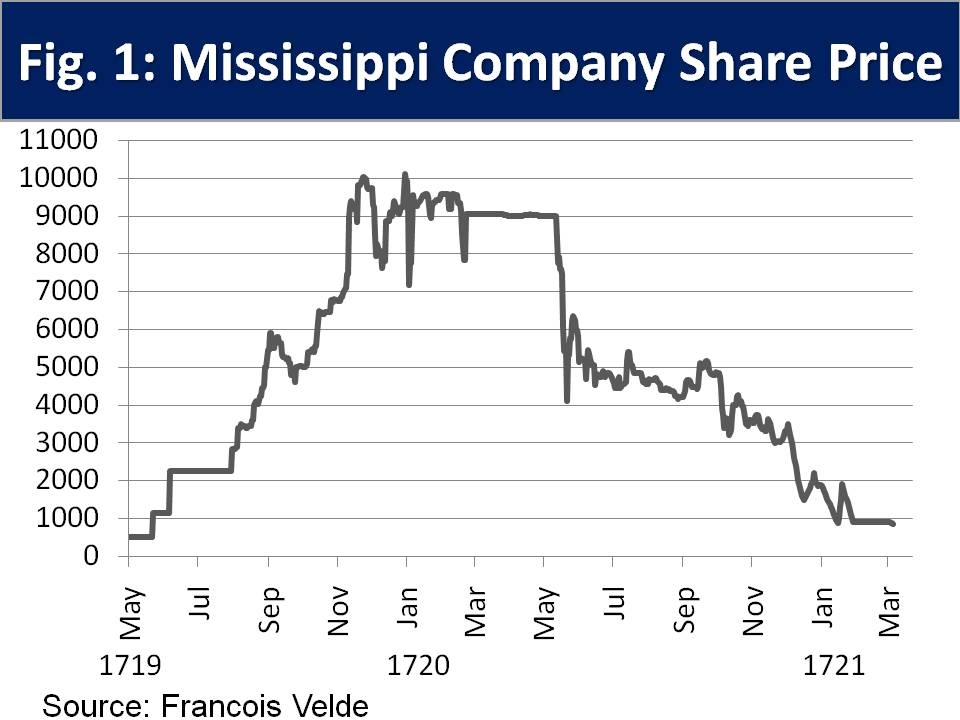
The second example is the Mississippi Bubble of 1718. Now this economic bubble is well documented, and there are some fantastic books written about it if you are interested. But I will give you a quick summary. In May 1716, John Law started a private bank with the majority of its capital being linked to government notes. Soon after he created a joint-stock company called Compagnie d'Occident (the Mississippi Company), the company had a monopoly over trade with the West Indies and the North American colonies. That soon after in 1718 became the Royal Bank, meaning that it was guaranteed by the king, and then absorbed all its competition for trade of China and the East Indies. The result was an agreement which stated that the national debt would be paid off by revenues from the Mississippi Company. Law exaggerated the wealth of the Mississippi Valley, namely its rich mineral deposits. The result was a mania for the joint-stock company. The company stocks and its violent appreciation demanded the issuance of more paper bank notes. By 1720, the craze had spiraled almost out of control and the French government admitted the paper notes exceeded the total value of its coinage which ultimately burst the bubble.
(Source: Francois Velde)
So what's the point? How does any of this relate to the price of Bitcoin? The answer is these two bubbles had definable and short-lived catalysts that broke some of the standard practices of finance that have evolved over the centuries. In the case of Bitcoin specifically, we haven't seen that catalyst. Perhaps the reversal of CBOE futures on the cryptocurrency will save it from the possibility of a catastrophic collapse.
Now, why did I say if these historical bubbles look like cryptocurrencies and not just Bitcoin? Well, the answer is simple: there exist other cryptocurrencies which follow similar trends as Bitcoin (obviously). After the reversal of Bitcoin futures, the price took a dive and has rocked around $14-15K, down from its $19K highs. Now whether it can muster the strength to recover remains to be seen. However, I believe there is a much more attractive opportunity which remains for investors: Ethereum.
At a glance, the two look like very similar stories. Some random virtual currency with violent growth. Yet, a closer look reveals how different Bitcoin and Ethereum are. First and foremost, they are almost entirely different: in design and purpose. Though they both use blockchain technology, Bitcoin was designed specifically as a digital currency. Yet, transaction confirmations take up to several minutes with Bitcoin, making it entirely unviable for long-term widespread use (this was one of the reasons for the Bitcoin Cash fork). For Ethereum, transaction confirmation takes several seconds.
While coded differently, Ethereum's main advantages come with its SmartContract and Distributed Applications uses. Basically, in a nutshell, Ethereum allows for various specialized peer-to-peer programs and specializations to be built into each token without any downtime. Such versatility and security will surely give it a sharp advantage in the long-term over Bitcoin.
So what exactly is a "SmartContract"? Well, it is a protocol which allows for two parties to negotiate and verify an agreement virtually without a third party. Without the third party, transaction costs are significantly reduced while security is increased. The reason for this is that the terms of the deal can be virtually embedded and verified by the blockchain itself before any funds are transferred.
To add some icing on the cake, Ethereum also is backed by a rather large non-profit which oversees the platform's advancement and development, a centralized development hub for a decentralized platform. For those investors who are still eyeing cryptocurrencies, I recommend betting on the best horse for the long-run race ahead. My bets are placed on Ethereum. Stay tuned. Happy hunting.
Disclosure: I am/we are long ETHEREUM.
I wrote this article myself, and it expresses my own opinions. I am not receiving compensation for it (other than from Seeking Alpha). I have no business relationship with any company whose stock is mentioned in this article.
Original article and pictures take static2.seekingalpha.com site
Finance ‘Guru’ James Altucher Is Launching a Cryptocurrency Exchange
Lately across the web, mainstream media has been highlighting an individual named James Altucher an American author, hedge fund manager, podcaster, and financial jack-of-all-trades. These days Altucher has been riding the trend of the bitcoin phenomenon, and some people call him a “cryptocurrency guru.” This week, public records show Altucher and his colleagues plan to raise $10Mn USD to launch a digital assets trading platform.
The Man Mainstream Media Calls the ‘Guru of Finance’ Plans to Launch a Digital Currency Exchange
It’s hard not to notice James Altucher as his picture with his eccentric hair, and his commentary on finance, is all over the web. These days Altucher’s words are tethered to the subject of cryptocurrencies. Altucher has been around the financial circuit for quite some time as a well-known author, entrepreneur, and he’s sometimes called a “guru.” This week it was revealed in a U.S. Securities and Exchange Commission (SEC) filing that Altucher is backing a company called Bitzumi, Inc., which plans to launch a bitcoin exchange.
“Bitzumi is a vertically-integrated Bitcoin exchange and marketplace. Our mission is to drive growth to the cryptocurrency industry — We plan to launch our business divisions with a phased approach,” explains the firm’s SEC filing on January 4.
Initially, our primary focus will be to develop a publishing and marketing company to educate potential Bitzumi exchange/wallet consumers, and to gain name recognition — Ultimately, we intend for our primary product to be our cryptocurrency exchange and digital storage — We also plan to develop various educational and information products and newsletters focusing on the cryptocurrency industry.
James Altucher has been promoted as ‘cryptocurrency guru’ by the mainstream media.
Bitzumi Exchange Plans to Raise $10 Million and Publish a Newsletter Backed by James Altucher
The co-founder, Altucher, and his company hope to raise $10 million USD, with a minimum of $1Mn for Bitzumi’s initial phases. The first phase will be a newsletter procured by Altucher, and the firm started period already on October 9, 2017, when Bitzumi Publishing partnered with Altucher’s Agora Financial, LLC. Phase two will be the exchange and wallet system, two services that Bitzumi says will compete with the likes of large exchanges like Bitstamp. Initially, Bitzumi will offer bitcoin, litecoin, ripple, and ethereum trades.
Bitzumi’s application details that the business will also offer cryptocurrency payment processing and escrow features. Additionally, the exchange will be fully regulated working with U.S. officials from Fincen, SEC, CFTC, and the IRS. The business venture looks like it will be relying heavily on Altucher’s backing and his newsletter, but Bitzumi will be led by the chief executive officer, Scot Cohen, an executive involved with oil and gas entities. Becoming a business involved with popular digital currencies, Bitzumi aims to be positioned as an “emerging growth company” the filing emphasizes.
What do you think about James Altucher and his plans to start a cryptocurrency exchange? Let us know your thoughts on this story in the comments below.
Images via Recode, Youtube, and the Bitzumi SEC filing.
Want to create your own secure cold storage paper wallet? Check ourtools section.